

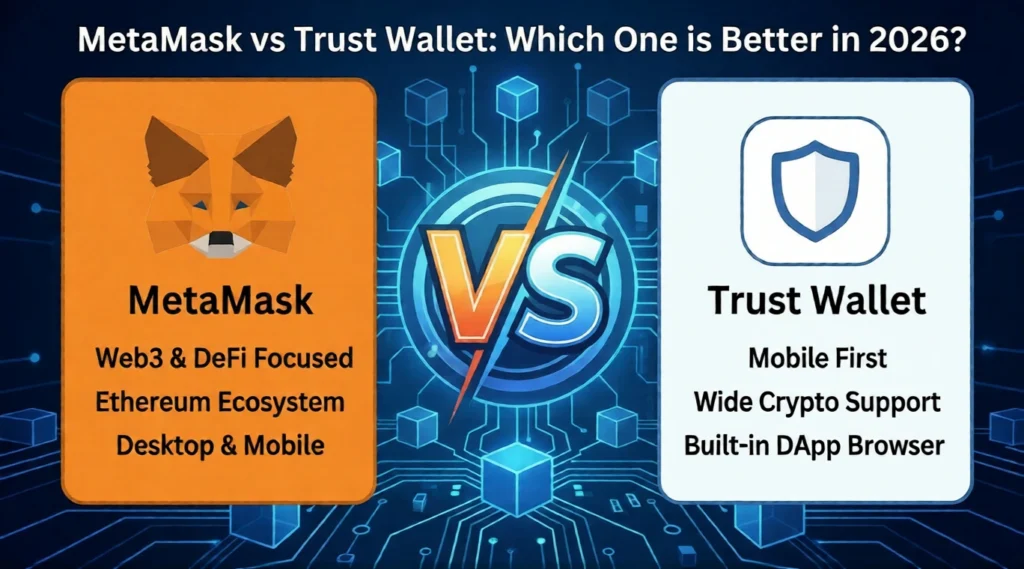
Choosing the right cryptocurrency wallet is one of the most critical decisions you will make as an investor. With so many options available, the debate often comes down to two heavyweights: MetaMask vs Trust Wallet. Both are incredibly popular, free to use, and trusted by millions of users worldwide. However, they serve slightly different purposes and audiences.
If you are trying to decide which one to use for storing your Bitcoin, Ethereum, or NFTs, you have come to the right place. In this comprehensive guide, we will break down the MetaMask vs Trust Wallet battle, analyzing their user interface, supported blockchains, security features, and built-in tools. By the end of this article, you will know exactly which wallet fits your crypto lifestyle in 2026.
1. What is MetaMask?

Before diving into the MetaMask vs Trust Wallet comparison, let’s look at the contenders.
MetaMask is the leading browser extension and mobile wallet for the Ethereum ecosystem. Launched in 2016 by ConsenSys, it was originally designed to bridge the gap between regular web browsers (like Chrome) and the Ethereum blockchain.
- Best For: Users who interact heavily with DeFi apps, NFT marketplaces (like OpenSea), and Ethereum-based games.
- Supported Chains: Ethereum, Binance Smart Chain (BSC), Polygon, Avalanche, Arbitrum, and other EVM-compatible networks.
- Primary Device: Desktop (Browser Extension) & Mobile.
2. What is Trust Wallet?

On the other side of the MetaMask vs Trust Wallet ring is Trust Wallet. Acquired by Binance in 2018, Trust Wallet is a mobile-first powerhouse designed for simplicity and broad asset support.
Unlike MetaMask, which focuses on Ethereum-like chains, Trust Wallet is chain-agnostic. This means it supports almost every major cryptocurrency out of the box, including Bitcoin, XRP, and Cardano.
- Best For: Beginners and investors who want to hold a diverse portfolio of different coins in one place.
- Supported Chains: Bitcoin, Ethereum, Solana, XRP, Tron, and 65+ other blockchains.
- Primary Device: Mobile App (iOS & Android).
3. MetaMask vs Trust Wallet: The Core Differences
To understand which wallet is superior, we must look at the technical specifications. The MetaMask vs Trust Wallet comparison highlights distinct advantages for each platform.
Supported Cryptocurrencies
This is the biggest differentiator in the MetaMask vs Trust Wallet debate.
- MetaMask: Strictly supports Ethereum and EVM (Ethereum Virtual Machine) compatible chains. It does NOT support Bitcoin (BTC), Solana, or XRP natively. If you want to store Bitcoin on MetaMask, you have to use a “wrapped” version like wBTC.
- Trust Wallet: Supports over 4.5 million assets across 65+ blockchains. You can store native Bitcoin, Ethereum, Solana, and Dogecoin all in the same app without any complex setup.
User Interface (UI) and Experience
- MetaMask: The interface is clean but can be technical. Adding new networks (like Binance Smart Chain) often requires manual input of RPC details, though this has improved recently. It is the gold standard for connecting to dApps (Decentralized Applications) on a desktop.
- Trust Wallet: Designed for ease of use. The UI is modern, intuitive, and perfect for beginners. It has a built-in “Earn” tab where you can stake coins with one click.
4. Security Comparison: MetaMask vs Trust Wallet
When comparing MetaMask vs Trust Wallet, security is the top priority. Both are “Non-Custodial” wallets, meaning you control the private keys, not the company.
MetaMask Security
MetaMask is open-source, meaning its code is constantly audited by the community. However, because it is a browser extension, it is more susceptible to “phishing” attacks. Hackers often create fake websites that pop up a fake MetaMask window asking for your seed phrase.
- Pros: Open-source code, high community trust.
- Cons: vulnerable to browser-based malware.
Trust Wallet Security
Trust Wallet operates primarily as a mobile app (sandboxed environment), which adds a layer of security against browser-based scripts. It also supports biometric login (FaceID/TouchID).
- Pros: Biometric security, secure mobile environment.
- Cons: Not fully open-source (the code is not entirely public for everyone to review).
Winner in Security: It is a tie. Both are secure “Hot Wallets,” but neither is as safe as a Hardware Wallet (like Ledger).
5. Features: Swapping, Staking, and dApps
The MetaMask vs Trust Wallet battle isn’t just about storage; it’s about what you can do with your crypto.
Built-in Swaps
Both wallets allow you to swap tokens directly inside the app.
- MetaMask: Aggregates data from multiple decentralized exchanges (DEXs) to give you the best price, but charges a hefty service fee (0.875%).
- Trust Wallet: Also offers in-app swaps and connects directly to Binance DEX for some assets. The experience is generally smoother for cross-chain swaps (e.g., swapping BTC for ETH using ThorChain integration).
dApp Browser
- MetaMask: It is the king of dApps. Almost every crypto website (Uniswap, Aave, OpenSea) has a “Connect MetaMask” button by default.
- Trust Wallet: Includes a built-in Web3 browser on Android. On iOS, due to Apple’s restrictions, the dApp browser was removed, and users must use “WalletConnect” to link to websites. This gives MetaMask a slight edge for iOS users who use DeFi heavily.
6. MetaMask vs Trust Wallet: Which One Should You Choose?

After analyzing the MetaMask vs Trust Wallet features, here is the final verdict based on user profiles.
Choose MetaMask If:
- You mainly use Ethereum and EVM chains (BSC, Polygon, Avalanche).
- You prefer trading and using dApps on a Desktop/Laptop.
- You are an NFT collector or DeFi power user who needs advanced transaction controls.
Choose Trust Wallet If:
- You are a beginner who wants a simple, all-in-one mobile app.
- You hold Bitcoin, XRP, Solana, or other non-Ethereum coins.
- You want to easily stake coins and earn interest directly from your phone without complex setups.
Conclusion
In the MetaMask vs Trust Wallet showdown, there is no single winner—only the right tool for the job. Many experienced crypto investors actually use both. They use Trust Wallet on their phone for holding Bitcoin and checking prices, and MetaMask on their browser for interacting with DeFi protocols.
Whichever you choose, remember that both are hot wallets connected to the internet. For large amounts, always consider moving your funds to cold storage.
👉 Looking for maximum security? Read our guide on How to Secure Your Crypto Wallet to protect your new wallet from hackers.


