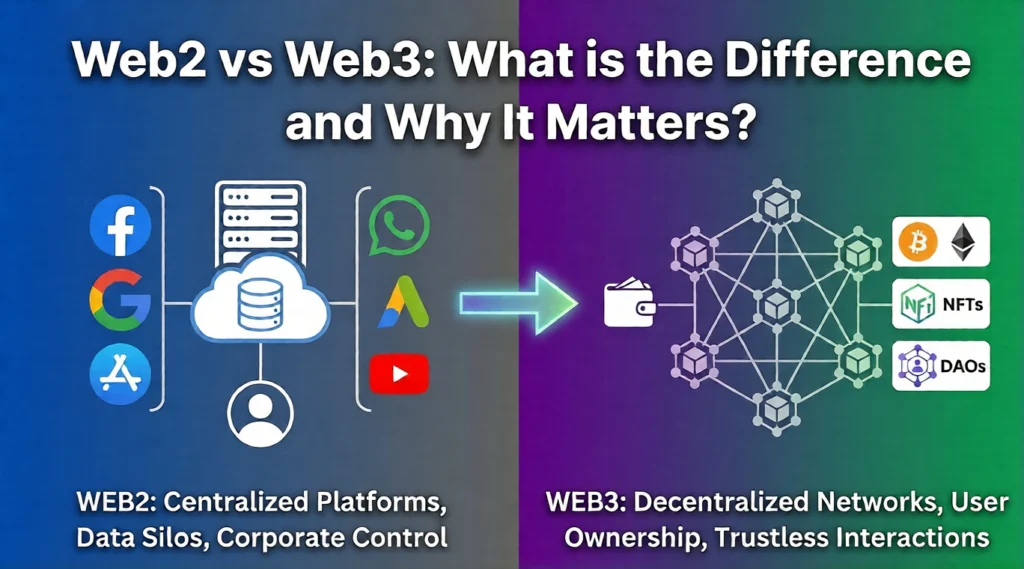
The internet is evolving. You might have heard people saying that “Web3 is the future,” but what does that actually mean? To understand where we are going, we need to look at where we came from. The debate of Web2 vs Web3 is not just about technology; it is about ownership, power, and freedom.
Currently, we live in the era of Web2 an internet dominated by tech giants who own your data. Web3 promises to change that. In this guide, we will break down the Web2 vs Web3 comparison to show you how the internet is shifting from “Corporate Control” to “User Ownership.”
1. The Evolution of the Web
To grasp the Web2 vs Web3 concept, let’s briefly look at the history.
Web1 (1990-2004): Read-Only This was the “static” internet. You could read news and visit simple pages, but you couldn’t interact. It was like a digital library.
Web2 (2004-Present): Read-Write This is the internet we use today. Social media, blogs, and YouTube. You can create content, post photos, and comment.
- The Catch: You create the content, but platforms like Facebook, Google, and Twitter own the data and monetize it.
Web3 (The Future): Read-Write-Own Web3 adds the layer of “Ownership” via blockchain. You can post content, and you actually own it as a token or NFT. No central authority can delete it or ban you.
2. Web2 vs Web3: The Core Differences

Let’s look at the direct comparison. The Web2 vs Web3 distinction changes the fundamental rules of the internet.
| Feature | Web2 (Current) | Web3 (Future) |
| Focus | Social & Interaction | Ownership & Value |
| Data Storage | Centralized Servers (AWS, Google) | Decentralized (IPFS, Blockchain) |
| Payment System | Banks, PayPal, Credit Cards | Crypto Wallets (ETH, SOL, BTC) |
| Censorship | High (Twitter can ban you) | Low (No one can delete the blockchain) |
| Identity | Email & Password | Wallet Address |
As you can see in this Web2 vs Web3 table, the power shifts from the company to the user.
3. Why Web3 Matters: True Ownership
The biggest argument in the Web2 vs Web3 debate is ownership.
In Web2, if you buy a “skin” in a video game like Fortnite, you don’t really own it. If the game shuts down, your money is gone. In Web3, that skin is an NFT (Non-Fungible Token). It lives in your wallet. Even if the game shuts down, you still hold the asset and can potentially sell it on a secondary market.
👉 Related: Learn the technology behind this in our What is a Smart Contract guide.
4. Real-World Examples of the Shift
How does the Web2 vs Web3 transition look in practice?
- Browser: Chrome (Web2) ➡️ Brave Browser (Web3)
- Storage: Google Drive (Web2) ➡️ Filecoin / IPFS (Web3)
- Social Media: Twitter (Web2) ➡️ Lens Protocol (Web3)
- Finance: Chase Bank (Web2) ➡️ Uniswap / Aave (Web3)
Conclusion
The transition won’t happen overnight, but the Web2 vs Web3 revolution is already underway. Web2 gave us connection, but it cost us our privacy. Web3 offers a chance to reclaim that privacy and own a piece of the internet we help build.
Whether you are an investor or just a user, understanding this shift is crucial for navigating the next decade of digital innovation.